
Global Warming & Climate Change
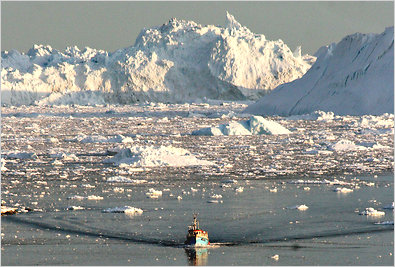
Steen Ulrik Johannessen/Agence France-Presse
Global warming has become perhaps the most complicated issue facing world leaders. Warnings from the scientific community are becoming louder, as an increasing body of science points to rising dangers from the ongoing buildup of human-related greenhouse gases — produced mainly by the burning of fossil fuels and forests.
Global emissions of carbon dioxide jumped by the largest amount on record in 2010, upending the notion that the brief decline during the recession might persist through the recovery. Emissions rose 5.9 percent in 2010, according to the Global Carbon Project, an international collaboration of scientists. The increase solidified a trend of ever-rising emissions that scientists fear will make it difficult, if not impossible, to forestall severe climate change in coming decades.
However, the technological, economic and political issues that have to be resolved before a concerted worldwide effort to reduce emissions can begin have gotten no simpler, particularly in the face of a global economic slowdown.
For almost two decades, the United Nations has sponsored annual global talks, the United Nations Framework Convention on Climate Change, an international treaty signed by 194 countries to cooperatively discuss global climate change and its impact. The conferences operate on the principle of consensus, meaning that any of the participating nations can hold up an agreement.
The conflicts and controversies discussed are monotonously familiar: the differing obligations of industrialized and developing nations, the question of who will pay to help poor nations adapt, the urgency of protecting tropical forests and the need to rapidly develop and deploy clean energy technology.
But the meetings have often ended in disillusionment, with incremental political progress but little real impact on the climate. The negotiating process itself has come under fire from some quarters, including the poorest nations who believe their needs are being neglected in the fight among the major economic powers. Criticism has also come from a small but vocal band of climate-change skeptics, many of them members of the United States Congress, who doubt the existence of human influence on the climate and ridicule international efforts to deal with it.
Carbon Credits Gone Awry Raise Output of Harmful Gas
When the United Nations wanted to help slow climate change, it established what seemed a sensible system. Greenhouse gases were rated based on their power to warm the atmosphere. The more dangerous the gas, the more that manufacturers in developing nations would be compensated as they reduced their emissions.
But where the United Nations envisioned environmental reform,some manufacturers of gases used in air-conditioning and refrigeration saw a lucrative business opportunity. They quickly figured out that they could earn one carbon credit by eliminating one ton of carbon dioxide, but could earn more than 11,000 credits by simply destroying a ton of an obscure waste gas normally released in the manufacturing of a widely used coolant gas.
That is because that byproduct has a huge global warming effect. The credits could be sold on international markets, earning tens of millions of dollars a year. That incentive has driven plants in the developing world not only to increase production of the coolant gas but also to keep it high — a huge problem because the coolant itself contributes to global warming and depletes the ozone layer. That coolant gas is being phased out under a global treaty, but the effort has been a struggle.
Fonte: https://topics.nytimes.com/top/news/science/topics/globalwarming/index.html
We still have time to alleviate this situation!
By: Iany Vagmacker ; )